

Science experiments are powerful tools for discovery. They transform abstract scientific ideas into hands-on moments of understanding, whether performed in a classroom, a kitchen, or a backyard. The magic of science does not come only from complex laboratory equipment. It emerges from curiosity, observation, and the willingness to test ideas in the real world. This is exactly why science experiments remain one of the most effective methods for teaching kids, supporting home learning, and inspiring toddlers to explore the world safely and joyfully. The demand for engaging, well-explained science experiments has grown tremendously, particularly as families and educators seek meaningful activities that strengthen critical thinking and fuel imagination.
This comprehensive guide explores how science experiments work, why they are essential for cognitive development, and how parents, teachers, and learners of all ages can use them to build scientific literacy. You will also find research-supported insights and examples that elevate these activities from simple fun to impactful learning moments. Whether you are looking for science experiments for kids, science experiments for toddlers, or creative challenges for teens, this article provides everything needed to begin or deepen a science-focused journey.
Why Science Experiments Matter for Every Age Group
Science experiments are far more than entertaining projects. They develop essential skills that shape how individuals understand and interact with the world. When children conduct experiments, they are not simply mixing ingredients or observing reactions. They are learning foundational principles of physics, chemistry, biology, and earth science through direct experience. This form of experiential learning is proven to strengthen memory retention, deepen comprehension, and promote problem-solving abilities.
Toddlers benefit from science experiments in a different way because early sensory experiences shape their cognitive development. Simple, safe experiments allow toddlers to engage with textures, colors, sounds, and natural phenomena. Pouring water, observing bubbles, watching ice melt, or exploring magnets helps them form early scientific reasoning. Researchers consistently demonstrate that early exposure to hands-on discovery builds stronger neural connections and encourages curiosity that continues throughout childhood.
For school-aged kids, science experiments cultivate analytical reasoning. They teach students how to ask questions, make predictions, test hypotheses, and interpret results. These skills extend far beyond the science classroom. They apply to mathematics, literacy, and creative arts. Most importantly, they help young learners become confident thinkers in a world increasingly shaped by technology and data.
Adults also benefit from conducting science experiments. Engaging in scientific activities can refresh knowledge, spark creative thinking, and support family bonding. Many parents enjoy conducting weekend projects with their kids, turning the home into an informal laboratory where learning happens naturally.
The Core Principles Behind Effective Science Experiments
Successful science experiments share several essential characteristics that make them both educational and meaningful. Understanding these principles ensures that children and toddlers engage with experiments in ways that foster true comprehension rather than passive entertainment.
Experiments begin with curiosity. A child wonders why objects sink or float, why colors mix, or how plants grow. This natural curiosity provides the foundation for scientific inquiry. Once a question emerges, the next step is forming a prediction. Predictions help children think logically and build early reasoning skills. When the experiment begins, children observe changes carefully and make connections between cause and effect. These observations lead to conclusions, which are among the most valuable parts of the scientific process. Conclusions teach children that scientific understanding evolves from evidence, not assumptions.
Safety is another key principle. When conducting science experiments for kids or science experiments for toddlers, materials should be non-toxic and appropriate for the child’s age. Adult supervision ensures that exploration remains safe and controlled. Safe experiments rely on simple household items such as water, vinegar, baking soda, food coloring, or natural elements like leaves and rocks.
Repetition also plays a crucial role. When children repeat experiments or vary conditions, they strengthen their understanding. They begin to recognize patterns and inconsistencies, which leads to deeper learning. The iterative nature of science mirrors the real scientific process used in laboratories and research institutions worldwide.
Science Experiments for Kids That Build Knowledge and Confidence
Science experiments for kids are most effective when they blend excitement with practical education. Many of the most enjoyable activities involve chemical reactions, color changes, motion, temperature shifts, and natural phenomena. Classic examples include observing how vinegar reacts with baking soda, creating simple circuits, or testing the strength of magnets. The joy of watching a reaction unfold enhances the learning experience, making scientific principles memorable.
Kids science experiments often support curriculum goals in physics, chemistry, and biology. When children explore buoyancy using objects of different densities, they learn why some items float while others sink. When they create homemade volcanos or inflate balloons with baking soda and vinegar, they discover gas production and chemical reactions. When they observe growing seeds, they learn about germination, photosynthesis, and plant biology.
These activities also encourage creativity. A child who designs a bridge from household materials or constructs a simple pulley system is learning engineering concepts while expressing imagination. Engineering experiments blend science, technology, and mathematics, providing early exposure to STEM fields. This is especially important because children who engage with STEM activities at a young age are statistically more likely to pursue STEM careers later.
Furthermore, conducting science experiments at home or in school helps children develop resilience. Not all experiments work perfectly on the first try. When a project fails, children learn perseverance, adaptability, and the value of testing alternative solutions. These lessons extend beyond science and contribute to personal growth.
Science Experiments for Toddlers That Are Safe, Simple, and Developmentally Aligned
Science experiments for toddlers must prioritize safety and sensory exploration. The goal is not to teach formal scientific theories but to nurture early curiosity and introduce simple cause-and-effect relationships.
Toddlers thrive on sensory experiences. When they watch ice melt in warm water, observe colors blending into new shades, or play with safe baking soda and vinegar mixes, they form neural pathways that support later scientific thinking. Experiments that involve water, sand, bubbles, light, shadows, and magnets are ideal because they stimulate visual, auditory, and tactile senses.
Early childhood researchers emphasize that hands-on exploration enhances language development. When adults describe what toddlers see, touch, or hear, children acquire vocabulary that helps them interpret the world. Describing textures like smooth, rough, sticky, or slippery enriches linguistic understanding. Naming colors, temperatures, or movement strengthens early literacy and cognitive categorization.
Another key benefit of toddler science experiments is emotional development. By giving toddlers space to explore, adults build confidence. Toddlers learn that their actions cause changes, which strengthens autonomy and decision-making skills. Structured experiments also support attention span development because the unfolding changes capture interest and encourage children to observe over short periods.
The Science Behind Why Hands-On Learning Works
Hands-on science experiments align with well-established cognitive research. Neuroscientists note that the brain forms stronger memories when multiple senses engage simultaneously. When children see, touch, and sometimes hear scientific reactions, they store the learning more deeply than through passive reading or lectures. Kinesthetic learning, which involves physical activity, strengthens neural pathways and reinforces conceptual understanding.
Constructivist learning theory also supports hands-on experiments. This theory suggests that learners build knowledge actively rather than receiving it passively. By manipulating materials, testing ideas, and drawing conclusions, learners construct personal meaning from experiences. This approach works especially well for young learners who benefit from direct engagement.
Further research from the National Science Teachers Association confirms that inquiry-based learning enhances academic performance. Students who regularly engage in hands-on experiments show improved critical thinking, stronger problem-solving abilities, and greater enthusiasm for science. The benefits extend across all demographic groups, making science experiments a highly inclusive educational tool.
Also Read: Social Media Ranking Aelftech com: Complete 2025 SEO Guide
How to Create Meaningful Science Experiment Experiences at Home
Parents often believe that meaningful science activities require specialized materials or formal training. In reality, the home environment provides an exceptional laboratory because daily life is filled with natural scientific phenomena. Water in the sink can demonstrate fluid dynamics. Fruit in the kitchen can showcase ripening and decomposition. Light coming through the window can help children study shadows and reflection.
To make the most of science experiments at home, the learning environment should feel open and relaxed. Children should be encouraged to ask questions freely without fear of being wrong. Adults can guide discovery by posing open-ended questions such as what do you think will happen next or how do you think this changed. These questions stimulate reasoning without giving away the answers.
It is valuable to maintain a small collection of safe, inexpensive materials. Items like plastic cups, food coloring, baking soda, vinegar, magnifying glasses, and string support dozens of creative experiments. Nature walks also provide opportunities for scientific exploration. Observing insects, collecting leaves, or examining rocks introduces biology and earth science concepts without formal structure.
Documentation enhances learning too. When children draw what they saw or describe what happened, they strengthen communication skills and integrate scientific thinking with creativity. Older kids might enjoy writing simple summaries or keeping a science journal.
Integrating Science Experiments Into Classroom Learning
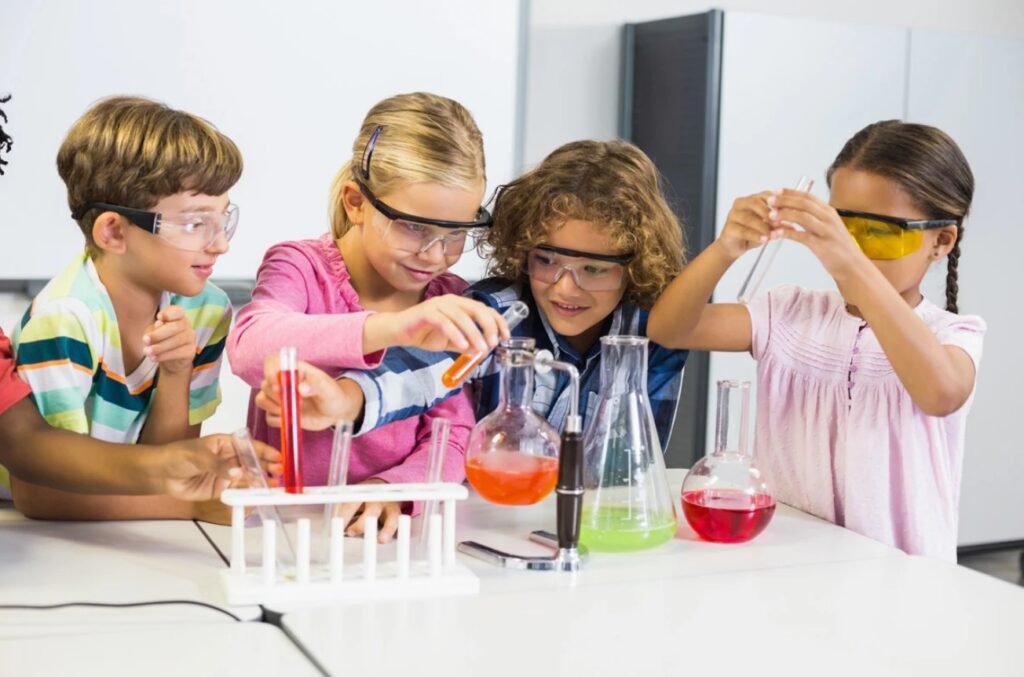
In the classroom, science experiments anchor curriculum objectives and make lessons more engaging. Teachers use hands-on investigations to introduce new concepts or help students internalize complex ideas. Classroom experiments also foster collaboration as students work together to analyze results and communicate findings.
Effective classroom experiments begin with clear objectives. Teachers identify the scientific principle to be explored, whether it involves gravity, states of matter, electricity, or natural cycles. Students then engage in a guided inquiry process. They pose questions, record predictions, observe changes, and discuss outcomes as a group. This collaborative method improves communication skills, strengthens social interaction, and encourages respect for diverse perspectives.
Assessment plays an important role. Rather than focusing solely on correct answers, educators evaluate students’ reasoning processes and ability to articulate what they observed. This approach aligns with the Next Generation Science Standards, which emphasize inquiry-based learning and real-world application.
Encouraging Lifelong Scientific Curiosity
The true value of science experiments extends beyond childhood. When children grow up accustomed to asking questions and seeking answers through observation, they carry those habits into adulthood. Curiosity becomes a mindset rather than a momentary interest. Adults who maintain scientific curiosity tend to make informed decisions, understand health information more effectively, and engage critically with technology.
Parents and educators can nurture this mindset by modeling curiosity themselves. When adults express fascination with nature, chemistry, or everyday scientific phenomena, children learn that science is not limited to textbooks. It becomes part of the world around them.
Also Read: Nvidia Shield Review Ultimate Streaming and Gaming Device
Real-World Examples of Scientific Concepts Explained Through Experiments
Science experiments illuminate everyday phenomena by breaking them into observable pieces. For example, children can understand density by comparing how oil, water, and syrup layer within a container. They learn that density determines whether substances float or sink. Similarly, experiments involving heat absorption and cooling rates help children understand energy transfer. Observing how different materials heat up under sunlight introduces concepts used in solar energy research.
In biology, growing seeds in transparent containers allows children to observe roots, stems, and leaves developing over time. This visual understanding helps them grasp the functions of plant parts and the importance of sunlight, water, and soil nutrients. Experiments with yeast and sugar introduce microbiology and chemical reactions, opening the door to conversations about metabolism and fermentation.
Physics becomes accessible through simple activities that demonstrate motion and force. Rolling objects of different weights down a slope helps children see how mass affects acceleration. Creating simple parachutes introduces drag and air resistance. These accessible projects bring scientific principles to life in memorable ways.
The Role of Creativity in Scientific Experimentation
Science is often associated with logic and precision, but creativity is equally essential. Many scientific breakthroughs emerged from the willingness to imagine new possibilities. Children naturally express creativity during experiments, especially when given freedom to modify materials or test variations.
Encouraging creativity strengthens flexible thinking, an essential skill in problem solving. When children propose alternative ways to conduct an experiment, they are participating in genuine scientific inquiry. They learn that science is not about finding one correct answer but about exploring many possible solutions.
Building Confidence Through Exploration and Discovery
Confidence grows when children see the results of their actions. Science experiments provide this tangible feedback. When a child predicts an outcome and observes it happening, they feel empowered. If the result differs from the prediction, they gain resilience and develop new ways of thinking.
This confidence extends into academic performance. Students who regularly engage with hands-on experiments exhibit stronger self-efficacy and are more likely to participate in classroom discussions. They develop comfort with trial and error, which supports lifelong learning.
H2: Science Experiments in the Digital Age
Modern technology has introduced new opportunities for scientific exploration. Digital microscopes, simulation apps, and augmented reality tools can enhance traditional experiments and bring microscopic or invisible phenomena into view. Children can observe cells, analyze planetary motion, or visualize chemical reactions using digital aids.
However, technology should supplement rather than replace hands-on experiences. Real-world experimentation provides physical feedback that digital simulations cannot replicate. The best learning environments combine both approaches to offer a well-rounded understanding of scientific principles.
Conclusion
Science experiments open doors to discovery. They empower children, inspire toddlers, and engage learners of all ages in meaningful exploration. By observing reactions, testing ideas, and uncovering patterns, children gain essential skills that extend far beyond science. They build critical thinking, strengthen creativity, and develop resilience through hands-on learning. Whether conducted at home, in school, or outdoors, science experiments transform curiosity into knowledge that lasts a lifetime.
Science experiments for kids spark excitement and build foundational understanding. Science experiments for toddlers nourish sensory development and early reasoning. Adults who participate in these activities alongside children help create a culture of inquiry that strengthens family bonds and promotes lifelong curiosity. As long as learners continue asking questions and seeking answers, science will remain a joyful and accessible pathway to understanding the world.
Frequently Asked Questions
What makes a science experiment educational
A science experiment becomes educational when it encourages children to ask questions, make predictions, observe outcomes, and draw conclusions. The learning occurs through active participation rather than passive observation.
Are science experiments safe for toddlers
Yes, as long as they use non-toxic materials and are supervised by an adult. Toddler-friendly experiments focus on sensory exploration and simple cause-and-effect relationships.
How often should kids do science experiments
Children benefit from regular hands-on learning. Even weekly experiments can significantly improve understanding, curiosity, and scientific reasoning.
Do science experiments require special equipment
Most meaningful experiments use everyday household materials. Specialized tools are optional and not necessary for foundational learning.